

In 2005, neuroscientist Rodrigo Quian Quiroga made a discovery that changed how we think about identity in the brain.
Studying epileptic patients at UCLA, he found something remarkable in one patient’s hippocampus: a single neuron that fired intensely whenever she saw a photo of Jennifer Aniston. Not when shown other actresses. Not other celebrities. Only Aniston.
The extraordinary part: it didn’t matter how Aniston looked. Black dress, hair up, jeans and T-shirt, laughing, crying — the neuron recognised the concept of Jennifer Aniston across any visual variation. It wasn’t matching a photo. It was firing in response to an idea.
And here’s where it gets truly interesting. When the patient was shown Aniston alongside the Eiffel Tower, the same neuron soon began firing in response to the Eiffel Tower alone. The cell had formed a new association — integrating new information into the existing concept of Jennifer Aniston. It didn’t store a new file. It evolved.
Quiroga called these “concept cells.” They live in the hippocampus, the brain’s seat of memory and identity. And they’re how the brain registers an entity as a persistent, coherent, recognisable self.
Every person in your life — your doctor, your banker, your best friend — has a concept cell in your brain. A living, evolving representation that fires when you think of them, regardless of context, and updates with every interaction.
Here’s the question that matters for AI agents: what would it take for a customer’s brain to build a Jennifer Aniston neuron for your AI agent?
The Test
Concept cells don’t form automatically. The brain builds them through repeated exposure to entities that exhibit stable, recognisable invariances. Your JAN for your doctor exists because your doctor is consistent. Same person across visits, same professional judgement, same commitments kept. Your brain has something stable to build around.
When the entity isn’t stable, the concept cell never forms. You don’t build a stable mental model of someone who contradicts themselves every conversation, forgets you between meetings, or feels like a different person on different days. Your brain, reasonably, refuses to anchor a persistent representation on shifting ground.
Now consider your customer interacting with your AI agent.
Today they have a conversation. The agent promises a small vehicle for delivery. Next week they return — the agent reads a chat log and pretends to remember, but it doesn’t know them the way a human would. A month later they come back on a different channel — the agent has no idea about the earlier interactions. The “same agent” told three different stories in three different sessions.
The customer’s brain is trying to build a concept cell. But there’s nothing stable to build around. So the customer never forms a JAN for your agent. They never achieve the neural recognition that underlies trust.
That’s the test. Not “is the agent smart?” Not “did it respond well?” But: can the customer’s brain form a concept cell for it?
What the Agent Must Provide
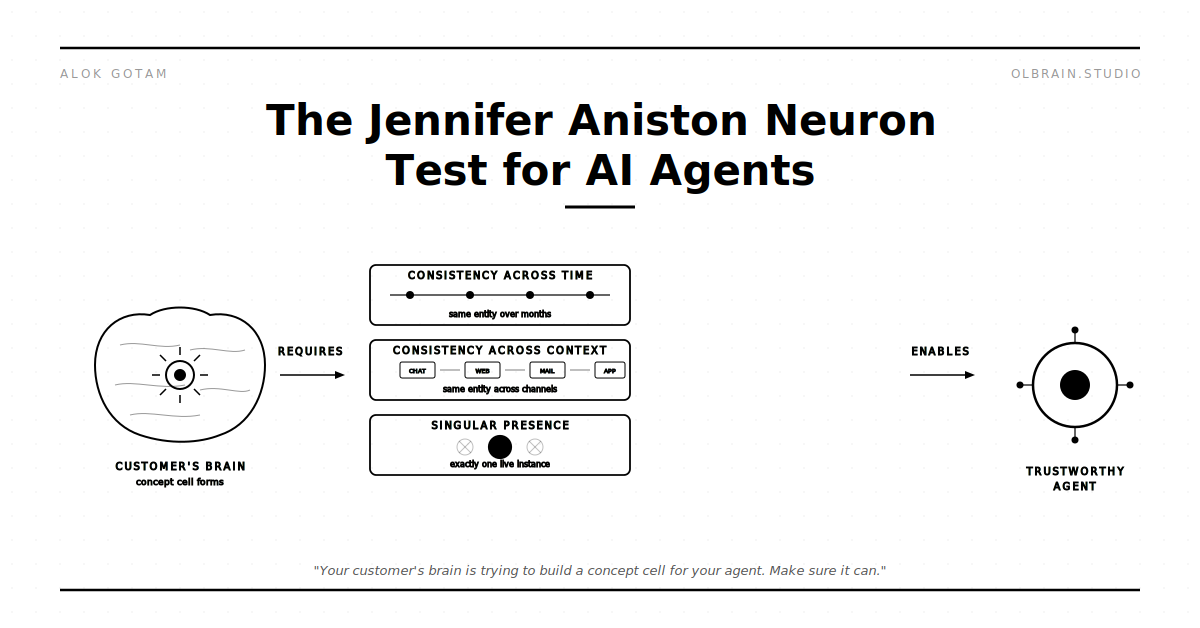
A Jennifer Aniston neuron forms because Jennifer Aniston exhibits three invariances — the very properties that make an entity “registerable” in another mind:
Consistency across time. Jennifer Aniston is the same entity today as last year. She’s evolved, of course — but continuously, coherently. Her story has a through-line. Your brain can build a stable concept cell because there’s a stable entity to model.
For an AI agent, this means the agent must exhibit narrative continuity — not across a chat log, but as a persistent world model that carries forward through every interaction. The customer who talked to the agent in January and returns in July must encounter the same evolving self, not a fresh instance pulling files.
Consistency across context. Jennifer Aniston is recognisably the same person whether she’s on a movie screen, a magazine cover, or a street corner. The concept cell fires across contexts because the entity is invariant across contexts.
For an AI agent, this means being the same entity across WhatsApp, the website, email, and every other channel. Same beliefs, same commitments, same evolving understanding. Not three different chatbot instances wearing the same brand name.
Singular presence. There is exactly one Jennifer Aniston. The concept cell can form a coherent representation because there’s one consistent entity being represented. If there were a hundred Jennifer Anistons all saying slightly different things, the concept cell would have nothing stable to anchor to.
For an AI agent, this means exactly one live instance of the agent’s identity at any time. Not ten parallel copies giving ten different customers slightly different answers. One singular entity whose commitments are traceable, whose state is unified, whose existence is verifiable.
The Reverse-Engineered Architecture
Notice what just happened. We started with a question about customer psychology — what does the human brain need to register an entity as trustworthy? — and ended with a three-part architectural requirement: consistency across time, consistency across context, singular presence.
These aren’t arbitrary design choices. They’re reverse-engineered from what the customer’s brain requires. The concept cell machinery has been shaped by millions of years of evolution to detect entities that are real, stable, and worth modelling. Anything that fails these tests doesn’t get a concept cell.
AI agents today fail all three tests. They’re inconsistent across time, fragmented across channels, and often running as multiple instances pretending to be one. No concept cell forms. No trust anchors. The relationship never takes off.
The engineering response isn’t to make agents smarter. It’s to give them the architectural properties that enable a customer’s brain to build a JAN for them.
Why This Matters Commercially
Here’s the practical implication: businesses are spending enormous resources trying to make AI agents “feel more human” — better tone, warmer language, more empathetic responses. These are the wrong optimisations.
What the customer’s brain is actually looking for isn’t warmth. It’s invariance. Stability. The signals that let the concept cell form. An agent with perfect tone but no persistent identity will feel forgettable — because the brain literally can’t form a stable representation of it.
Customers who form concept cells for agents become loyal. They develop something neurologically close to the relationship they have with a human professional they trust. That’s the unlock for the relationship market — wealth management, premium commerce, healthcare, insurance, education — where lifetime value compounds over years.
Customers who can’t form concept cells use the agent once, maybe twice, and move on. No neural anchor. No relationship. No long-term value.
The Bottom Line
Neuroscience has shown us how identity actually registers in the human mind. Not through better conversation. Not through smarter responses. Through the slow neural process of building a concept cell — which requires an entity that’s consistent across time, consistent across context, and singularly present.
That’s the test AI agents need to pass. Not “did the customer like the conversation?” but “can the customer’s brain form a Jennifer Aniston neuron for this agent?”
Most agents today fail this test by architecture, not by effort. They’re built on retrieval systems that don’t exhibit the invariances concept cells need.
Building agents that pass the JAN test is a different architectural challenge — one that’s just beginning.


Leave a Reply