

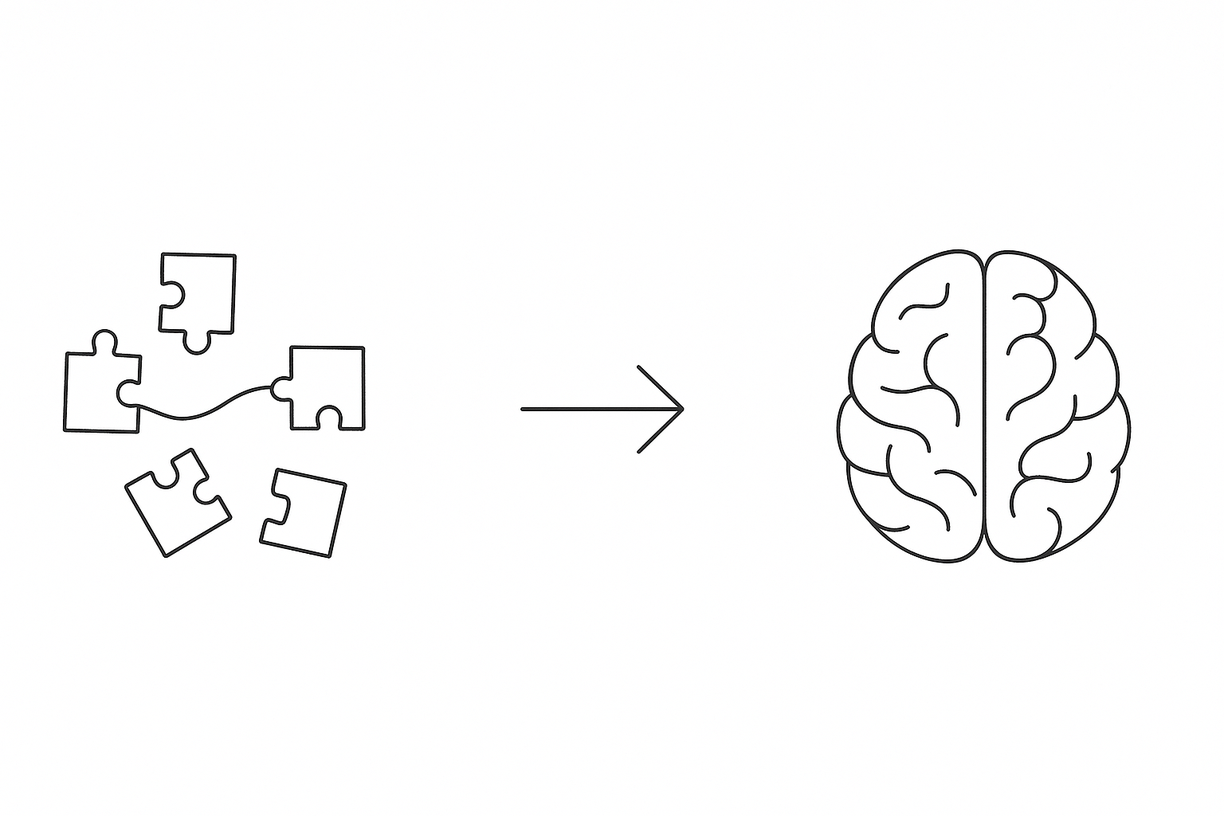
Suddenly, “Context Engineering” is having its moment.
The LLM gold rush gave us incredible models—but not intelligence. Not coherence. Not continuity. So the industry did what engineers always do: it built a workaround.
That workaround is now a discipline. It’s called Context Engineering.
It includes:
- Selecting the right documents (RAG)
- Structuring prompts with framing, memory, and intent
- Dynamically stitching in tools, policies, APIs, embeddings
It’s smart. It’s necessary. And it works—to a point.
But here’s the truth no one wants to admit:
Context engineering is a patch. Not a foundation.
It is a highly manual attempt to simulate cognition inside a system that lacks it.
What context engineering really is
At its core, context engineering is a form of manual Umwelt construction. Every time a model is prompted, a tiny “world” is stitched together just in time—data, memory, instructions, logic—all injected into the prompt.
But that “world”:
- Doesn’t persist
- Isn’t coherent
- Doesn’t evolve
- Can’t reflect
It’s a flat snapshot, not a living structure. And as models grow more powerful, stitching faster snapshots won’t make them think. It’ll just make them faster parrots.
That’s where Olbrain begins
Olbrain isn’t a model.
It’s not a prompt strategy.
It’s not a RAG layer.
Olbrain is a machine brain—a generative substrate that constructs structured cognition, not just context.
It builds Umwelts: coherent internal environments tied to purpose.
It can compose modular tools—LLMs, symbolic engines, memory graphs, causal inference—into a self-contained cognitive structure. Not to answer a question, but to support systems that can form narratives, decisions, and persistent selves.
Where context engineering hacks together a temporary frame, Olbrain builds an enduring structure.
Why this matters now
Today’s AI landscape is filled with smart wrappers around dumb models. Every agent is prompt-chained, every assistant is context-injected.
But nothing thinks in a real way.
Olbrain doesn’t inject intelligence. It grows structure.
It doesn’t simulate coherence. It hosts it.
And when those structures are connected to persistent identity through our CNE protocol, you don’t just get smarter outputs—you get agents with epistemic autonomy, accountability, and alignment.
We call the felt outcome eA³. And it can’t be achieved through better prompt tuning.
In summary
We think context engineering is important.
But we’re not building for it.
We’re building the thing that makes it obsolete.
Because the future of intelligence doesn’t depend on handcrafted input streams.
It depends on structured cognition—persistent, coherent, and capable of growing.
That’s what Olbrain exists to explore.
And that’s what comes after context engineering.


Leave a Reply to Winston Cancel reply