

GROUNDING STATELESS INTELLIGENCE IN IDENTITY MAKING IT ACCOUNTABLE
Introduction
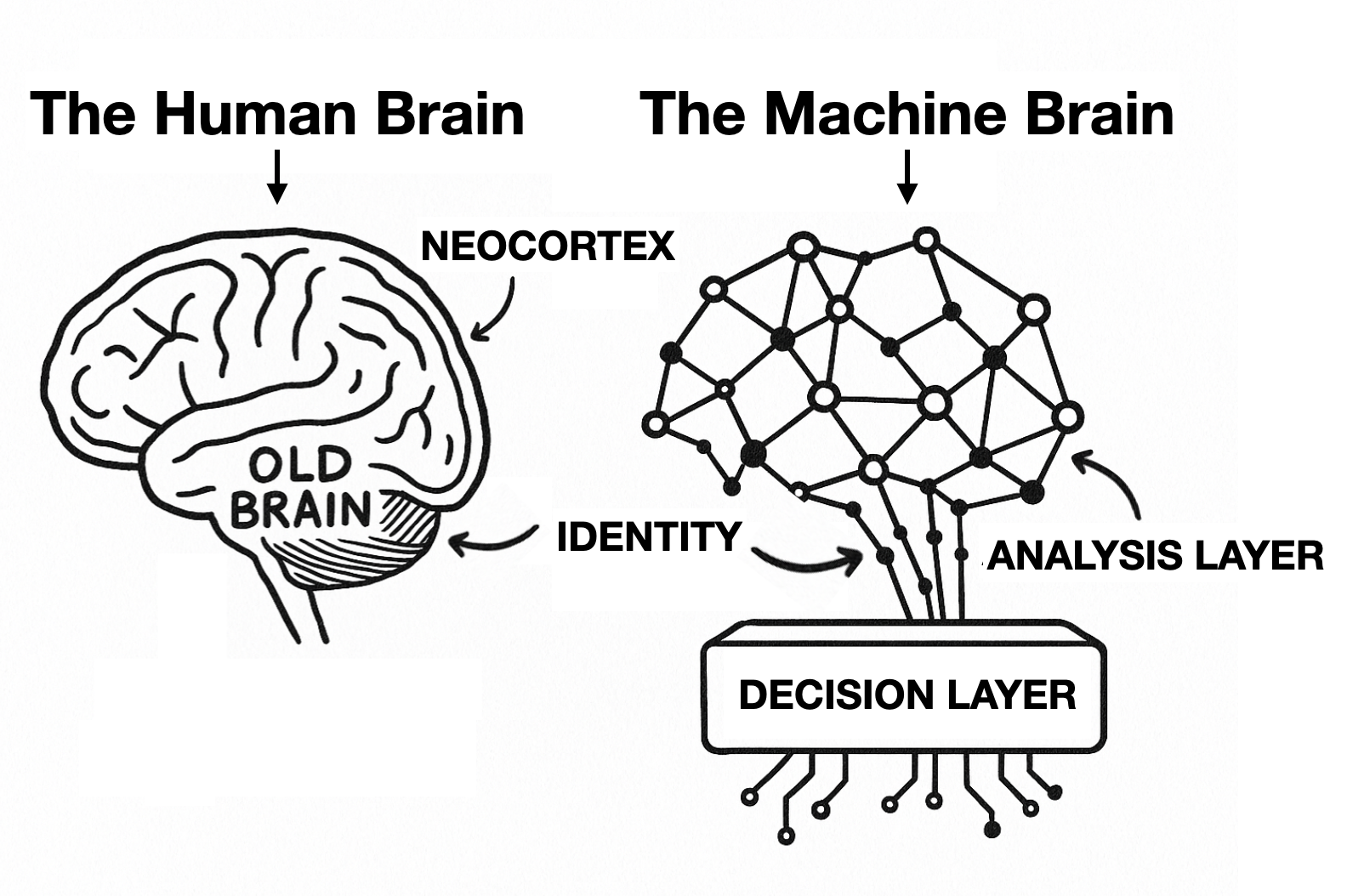
Artificial Intelligence (AI) has reached a stage where machines can demonstrate impressive reasoning, problem-solving, and language skills. Large Language Models (LLMs) and deep learning systems resemble the human neocortex in their ability to generate insights, interpret data, and communicate fluently. Yet, despite this intelligence, today’s AI remains disposable and stateless. Each interaction begins and ends in isolation; there is no persistence, no continuity, no accountability.
This whitepaper argues that intelligence without identity—and hence accountability—is incomplete. Stateless AI systems must be grounded in a cognitive substrate that confers them with persistent identity, enabling accountability. That cognitive substrate is Olbrain.
The Biological Blueprint
In humans and animals, the old brain—the brainstem and limbic systems—evolved long before the neocortex. Its functions included:
- Regulating survival (heartbeat, breathing, reflexes).
- Driving motivations (hunger, fear, bonding, reproduction).
- Anchoring persistence and continuity of the organism.
This endowed species with a continuous sense of self that allowed intelligence in the neocortex to act coherently and responsibly. Intelligence needed a similar substrate.
The AI Inversion
AI has developed in reverse.
- Intelligence-first: LLMs and DL systems provide reasoning, language, and problem-solving.
- No substrate: These systems are stateless, disposable, and lack identity or persistence.
The result: clever but fragile systems. They can answer questions but cannot be accountable across time. In short: we have intelligence without identity.
Why AI Needs a Cognitive Substrate
To be trustworthy and usable at scale, AI requires a substrate beneath intelligence—just as the old brain supports the neocortex. This cognitive substrate provides the grounding for identity and accountability.
Core Functions of the Cognitive Substrate (Olbrain):
- Persistent Identity (CNE Protocol): ensuring each agent has a unique, continuous self.
- Recursive Belief Revision (RbR): enabling logical updates, self-correction, and diachronic coherence.
- Umwelt: constructing goal-conditioned world models.
- Global Narrative Frame (GNF): ensuring long-horizon continuity and coherence.
- Core Objective Function (CoF): anchoring purpose and goals in both decision and action.
Without these, AI remains fragile and non-actionable. With them, intelligence becomes substrated—and thus accountable.
From Stateless Intelligence to Accountable Agents
Accountable Agent = Intelligence + Identity → Autonomy → Agency
- Without Identity: AI is just a tool—reactive, stateless, and disposable.
- With Identity: AI gains accountability, the precondition for autonomy and agency.
Accountable Agents are the usable form of AGI. They don’t just compute; they cognize, evolve, and act responsibly.
Evolution of Olbrain
Olbrain is the cognitive substrate for AI. Its development is staged across three versions, aligned with the multi-decadal roadmap of AGI:
- V1.0: The Machine Brain (by 2027) — grounding digital agents in identity and accountability.
- V2.0: The Cybernetics Brain (by 2032) — extending into embodied agents that interact with the physical world.
- V3.0: The Positronic Brain (by 2042) — enabling analogue, space-grade agents that support humanity’s expansion beyond Earth.
This roadmap powers the long-term evolution of accountable AGI.
Why This Matters Now
- Enterprise trust: Businesses need agents that are auditable, attributable, and persistent—not disposable scripts.
- Regulation: Frameworks like RBI’s FREE-AI demand accountability and traceability. Without identity, compliance is impossible.
- Trajectory of AGI: Substrated intelligence today lays the foundation for digital, embodied, and analogue agents tomorrow.
- Survival: Substrated intelligence paves the way for Robolization: deploying accountable intelligence beyond Earth to secure humanity’s long-term future.
Conclusion
In biology, identity and continuity underpinned intelligence. In AI, intelligence came first—but without a substrate, it remains incomplete and unaccountable.
Olbrain is the Cognitive Substrate: it transforms stateless intelligence into accountable agents by grounding them in persistent identity.
Substration is the Threshold of Agency. Substrated Intelligence is the Agency.


Leave a Reply to dostavka_igEi Cancel reply