

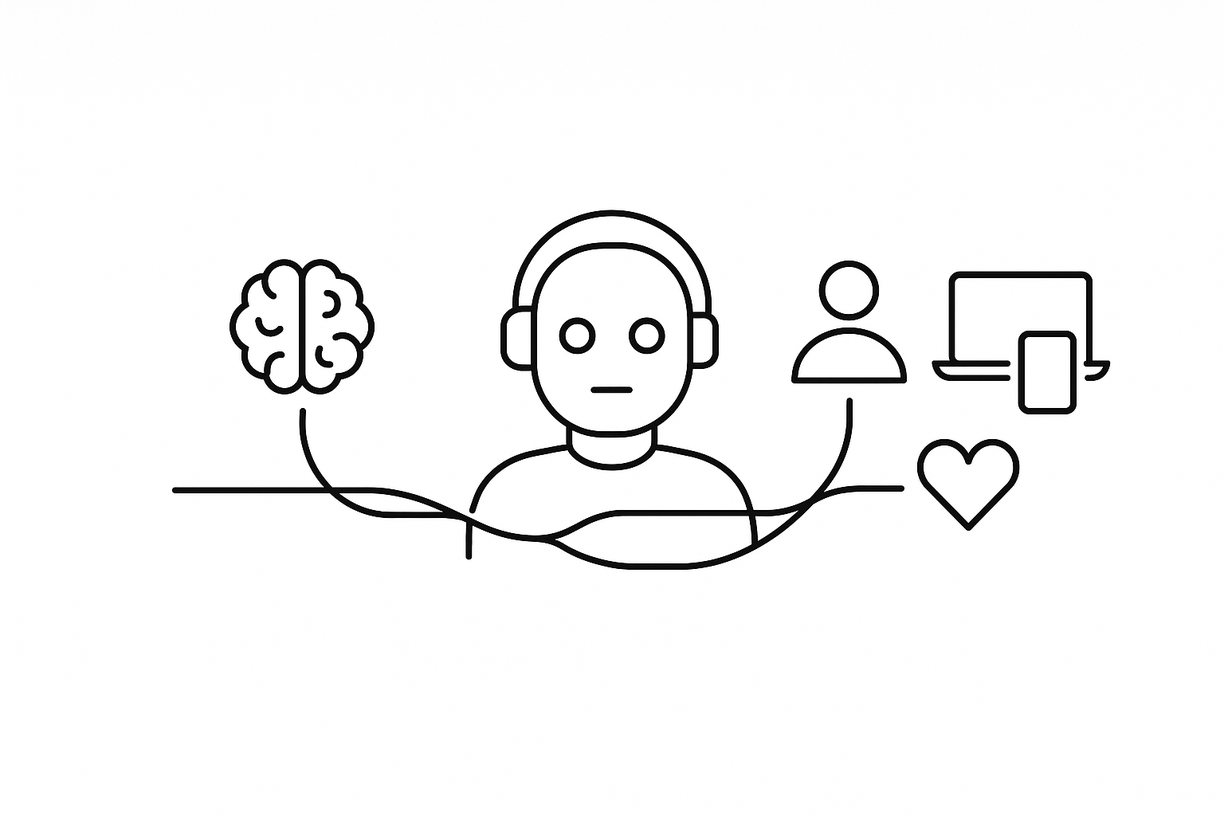
Persistent identity refers to an AI agent’s ability to maintain a continuous identity and memory across interactions, rather than treating each session as a blank slate. In practical terms, a persistent identity means the agent retains context from past conversations, remembers user preferences, and behaves in a consistent “persona” over time . This continuity transforms AI agents from one-off tools into reliable digital assistants or teammates. By contrast, most current AI systems are stateless – they forget everything outside a single conversation window, leading to fragmented experiences. Today’s popular AI platforms (e.g. ChatGPT, Claude, Bard) generally silo their memory to one session; using multiple tools leaves your “AI self” scattered with no shared context or continuity . Persistent identity is emerging as a critical missing layer that can unlock better user experiences and business value.
Concept of a portable AI identity: Instead of memory being siloed in each AI application, a persistent AI identity carries the user’s context and preferences across different models and tools . This ensures continuity and personalization no matter where the agent operates.
Defining Persistent Identity for AI Agents
In the context of AI agents, persistent identity means an agent retains a stable identity and state over time. Unlike a typical stateless chatbot that “resets” every new session, a persistent-identity agent continuously accumulates knowledge, context, and personality. It remembers past interactions across sessions and even across different platforms or channels. Key attributes of persistent identity include:
- Continuity of Memory: The agent can remember interactions across sessions and recall facts or context provided earlier . This could involve storing conversation history, facts learned, or user-specific information in long-term memory. For example, if a user told the agent last week about a preference or an issue, a persistent agent should recall that without being told again.
- Learning and Adaptation: Over time, the agent learns user preferences and patterns, adjusting its responses and behavior accordingly . The agent essentially “learns from experience,” much like a human would, rather than forgetting each exchange. This might manifest as the agent improving its answers based on prior corrections or personalizing its tone to the user’s style.
- Consistent Personality and State: The agent behaves as a consistent persona or identity that the user can come to recognize. It can act consistently in complex workflows and maintain a stable profile (e.g. knowledge of its role, context of its tasks) instead of switching unpredictably . This consistency also implies accountability – the agent’s actions can be tied back to its identity.
- Cross-Platform Portability: Ideally, a persistent identity could travel with the agent across different applications or interfaces. Instead of each chatbot or agent being an island, your AI assistant could be the same entity whether it’s interacting via a chat interface, voice assistant, email, or a business software tool . In other words, the agent’s identity isn’t confined to one app – it’s a portable layer that can plug into many systems.
In summary, persistent identity is about giving AI agents a long-term memory and a stable self, rather than an ephemeral session-bound existence. As one tech strategist put it: most current AI agents are “locked in” to platform-specific, session-limited memory, resulting in a fragmented experience with “no shared context, no continuity, no portability” between tools . Solving this means building an identity layer for AI – teaching it not just to remember, but to belong as a continuous presence in a user’s workflow.
Problems Caused by Lack of Persistent Identity
When AI agents lack persistent identity (i.e. they are stateless and forgetful), a number of problems arise that hurt both user experience and business outcomes:
- Broken Context & User Frustration: Without memory, each interaction starts from scratch. Users have to repeat information and context every time, as the AI doesn’t inherently know what was said before. This context re-establishment overhead is frustrating and inefficient . For example, a customer might explain their issue to a support chatbot, but if they return the next day, the bot has no recollection of the prior conversation. This leads to repetitive, circular dialogues. A research paper on long-term memory for LLMs illustrates this clearly: if a user mentions dietary preferences (e.g. vegetarian and dairy-free) in one session, a stateless AI might forget and later recommend an inappropriate meal, completely contradicting the user’s stated needs . Such memory failures force the user to correct the AI repeatedly and undermine trust in the agent’s usefulness .
- No Continuity = No Relationship: An AI that can’t remember past interactions will inevitably feel impersonal. It cannot build on prior conversations to develop rapport or understanding with the user. In business settings, this prevents relationship-building. Real customer or employee relationships rely on shared history and context – something stateless AI cannot accumulate . Every session feels like talking to a new, clueless agent, which erodes user confidence and loyalty. As one analysis noted, without persistent identity, trust breaks down and the AI remains a gimmick rather than a reliable tool . Users may perceive the agent as flaky or unhelpful if it contradicts itself or asks the same questions over and over.
- Inability to Learn or Improve: A stateless AI agent has no long-term memory of mistakes or user feedback. It cannot “learn” from corrections or adapt to user preferences over time. This means the agent might repeat the same errors. For instance, an AI that generates weekly reports might continually make the same formatting mistakes or omit the same data, because it doesn’t remember the corrections given last week . The lack of persistent memory thus stalls continuous improvement – the agent never gets better or more personalized with use, wasting the opportunity for AI to evolve with usage.
- User Confusion and Inconsistency: Without a persistent persona, the agent’s tone or answers might vary from session to session. The user cannot rely on a consistent style or viewpoint. In multi-step workflows, the agent might not recall earlier steps, causing confusion. This inconsistency can be disorienting – imagine a sales assistant AI that gives a client different recommendations each time because it doesn’t remember their requirements from prior meetings.
- Efficiency Losses: The need to re-educate the AI every time negates productivity gains. Rather than becoming more efficient over time, a stateless AI stays at the same level of inefficiency, since it never accumulates any “operational wisdom” . Teams might find themselves repeatedly providing background information or redoing work that an AI with memory could handle. The overhead of restarting context for each task or conversation reduces the net benefit of using the AI.
- Lack of Accountability and Personalization: If an AI agent doesn’t maintain an identity, it’s harder to hold it accountable for decisions or trace its actions. In enterprise settings, we want agents to operate under defined identities with audit trails. With no persistent identity, an agent’s actions across sessions can’t be easily traced back to a stable ID, complicating debugging and governance. Moreover, without tracking user identity or preferences, the agent’s responses remain generic – no personalization to the individual user or context. This one-size-fits-all behavior is a far cry from the tailored service that users expect and that businesses aim to provide.
Real-world scenarios highlight these pain points. One customer service example has an AI support agent that doesn’t remember a customer’s two prior calls: on the third call about the same issue, the stateless agent repeats the same troubleshooting script, frustrating the customer and forcing escalation to a human rep . The customer not only wastes time but loses trust in the support system. Similarly, consider a B2B sales agent that engages a prospect over a 6-month sales cycle. Without memory, each interaction feels disconnected – the agent fails to recall what was discussed last month or how the client’s needs have evolved . This disjointed experience undermines trust and could cost the sale, since the prospect perceives that the “AI salesperson” doesn’t understand them. In internal operations, an AI project management assistant with no memory cannot draw insights from past project data – it won’t notice that a certain risk has recurred in previous projects, for example, because it doesn’t retain that history . Across these cases, the enterprise cost of forgetfulness is high: user frustration, lost efficiency, broken trust, and a failure to fully offload work to the AI.
In sum, the lack of persistent identity and memory turns AI agents into perpetually amnesiac “goldfish.” They might perform single-turn tasks well, but they cannot form the long-term context that complex business interactions demand. As one AI expert succinctly noted, “Most AI agents today are brilliant, but forgetful… forcing users to start from scratch every time.” Without solving this, AI agents remain far less effective – and far less trusted – than they could be.
Benefits of Persistent Identity for AI Agents
Implementing persistent identity confers a host of benefits that directly address the above issues and unlock new capabilities:
- Seamless Continuity in Conversations: With persistent identity, an agent can pick up a conversation exactly where it left off, even if the last interaction was days or weeks ago. There’s no need for users to repeat themselves, as context carries over. The AI can refer back to earlier discussions, creating a smooth, human-like dialogue flow. Continuity means context compounds over time – each interaction builds on the last, making the agent’s assistance more efficient and deeply contextual . For example, an AI assistant that remembered a customer’s previous support ticket could start a new chat by asking if the prior issue was resolved, instead of starting with “How can I help you today?” This not only saves time but makes the customer feel heard and valued.
- Personalization and Improved User Experience: A persistent identity enables personalized interactions that improve over time . The agent can store user preferences, profile information, and interaction history, allowing it to tailor responses to the individual. Over multiple sessions, the AI learns a user’s preferred communication style, what solutions have worked for them before, and what their goals are. The result is an experience more akin to dealing with a knowledgeable assistant who “knows you.” In customer service, this might mean the AI automatically prioritizes solutions that fit the customer’s product configuration and past issues. In a sales context, an AI could adjust its product recommendations knowing what the client has already bought or shown interest in. Such personalization drives user satisfaction and engagement – when users feel the AI “remembers me and understands my needs,” their trust in the agent grows.
- Learning and Continuous Improvement: Persistently stateful agents can learn from feedback and adjust behavior accordingly . Mistakes don’t have to be repeated because the agent retains a memory of corrections or negative outcomes. Over time, the agent’s performance should improve as it accumulates more data about what works and what doesn’t. This is akin to human learning on the job. For instance, if an AI report generator is told that a certain data point was missing in last week’s report, a persistent agent can remember to include it going forward. In effect, the longer a persistent agent operates, the more it can refine its outputs to the specific domain or user. This continuous learning loop can boost accuracy and effectiveness, turning AI from a static tool into an evolving partner.
- Consistency and Trust Building: When an AI agent behaves consistently and holds onto a stable identity, users can develop trust in it. They’ll start to treat it as a reliable agent rather than a novelty. Consistency in voice, behavior, and knowledge means the AI becomes predictable in a good way – users know that if they tell something to the agent, it will remember, and if they return later, the agent will act in accordance with prior context. This reliability is critical for sensitive applications. One industry analysis noted that making AI agents reliable partners requires them to remember interactions and preferences over time – without that, the user’s confidence erodes . Conversely, with persistent memory, trust compounds. Business users might even begin to delegate more critical tasks to an agent once it has proven itself knowledgeable about their context and policies. There’s also a “loyalty loop” effect: when an AI feels personal and attuned to you, you’re more likely to stick with it (and by extension, stick with the product or platform that provides it).
- Efficiency and Productivity Gains: Persistence means no more resetting context, which directly saves time and effort. Teams can leverage AI to offload more work without the penalty of re-educating it each time. As the agent accumulates an institutional memory, it can handle multi-step processes autonomously. For example, a persistent digital assistant in a company could remember ongoing projects and proactively provide updates or reminders, reducing the need for human follow-ups. In a sense, continuity allows context to compound like interest, yielding increasing returns. A report by McKinsey (hypothetical example) might find that agents with long-term memory drastically reduce handle times in customer support or accelerate sales cycles thanks to continuity. Moreover, persistent identity can enable cross-platform efficiency: the same agent can roam across different tools with its knowledge intact . This eliminates the friction of context switching – you don’t have to repeat a directive in email that you already gave the AI assistant in chat.
- Accountability, Security and Compliance: In enterprise settings, giving each AI agent a persistent identity (much like a user identity) improves governance. The agent can be issued stable credentials and roles, and all its actions can be logged under that identity for auditing . This approach aligns with the principle of “identity-aware” AI operations – every autonomous action is tied to an agent ID, which has specific permissions and an audit trail . Persistent identity thus aids in security (no sharing of credentials between ephemeral instances; each agent has its own auth), and in accountability (we can trace which agent did what, when). It also helps ensure continuity of authorization: an agent that persists can maintain a secure session or token over long processes, whereas stateless agents would require re-authentication and might be harder to secure. In summary, treating AI agents as entities with persistent identity allows organizations to enforce policies, prevent impersonation, and maintain compliance more rigorously .
Overall, persistent identity turns AI agents from forgetful “goldfish” into increasingly capable “elephants” (renowned for memory). As one business tech blog put it, this shifts AI systems from being stateless function processors into stateful relationship participants that can truly collaborate with humans . Agents with long-term memory can build genuine working relationships, anticipate needs based on history, and even develop a kind of expertise in the context they operate. In the long run, the presence of a persistent identity layer is expected to make AI agents “sticky” — users become attached to their personalized AI assistant much like they would to a diligent coworker, which has implications for product adoption and loyalty .
Business Use Cases Enabled by Persistent Identity
Persistent identity for AI agents is particularly valuable in business contexts where interactions are multi-turn, ongoing, or span multiple systems. Some prominent use cases include:
- Customer Service and Support: Perhaps the clearest use case – a customer support AI agent with persistent identity can recall a customer’s past issues, preferences, and history of interactions. This means if a customer contacts support multiple times, the agent doesn’t treat them as a new person each time. It might greet them by name, acknowledge their previous problems (“I see you reached out about this issue before”), and avoid redundant troubleshooting steps. This leads to faster resolutions and a more satisfying experience. Crucially, it prevents the “Groundhog Day” support scenario where the customer has to restate their problem repeatedly. The impact is both on customer satisfaction and support efficiency. Studies have found that advanced AI customer service systems use memory to deliver personalized support and reduce repetitive queries . A memory-enabled “tier 1” support agent can handle common issues end-to-end and only escalate to humans for novel or complex cases. For example, Autonoly (a no-code AI platform) illustrated how a persistent-memory customer service agent would respond: “Hi Sarah, I see this is the third time you’ve contacted us about the billing discrepancy… I’ve already escalated this and applied a credit to your account” . This kind of response is only possible when the agent retains relationship context. Companies lacking this capability – where each chatbot session forgets the last – often suffer customer frustration and higher support costs.
- Sales and Virtual Assistants for Sales Teams: In sales, building rapport and tracking a prospect’s journey over time is key. An AI sales assistant with persistent identity can manage a prolonged conversation with a potential customer, remembering details like the client’s industry, past objections, or products of interest. Over a multi-month sales cycle, the AI can maintain a narrative of the relationship: e.g. “When we spoke last month, you were evaluating feature X – have your requirements changed?” Without this continuity, an AI would be of limited help in sales (since it might ask the prospect the same qualifying questions over and over). Persistent identity enables an AI sales agent to act almost like a dedicated account representative, ensuring each interaction builds on the last. This improves trust and could increase conversion rates because the prospect feels the AI “knows” their needs. On the flip side, sales agents use multiple channels (email, chat, CRM notes) – a portable AI identity could follow across these, aggregating knowledge. Businesses are exploring such AI assistants to nurture leads, send personalized follow-ups, and even make recommendations by drawing on the entire interaction history with the lead . For instance, if a customer previously said budget is a concern, the AI can later proactively share a discount or a cost-benefit analysis aligned to that concern.
- HR Assistants and Employee Support: AI agents are increasingly being used internally to answer employees’ HR questions (about benefits, policies, payroll, etc.) and even to onboard new hires. A persistent identity is valuable here because the agent can maintain an “employee profile” context. It would know, for example, that you are a new hire versus a tenured employee, or that you’ve asked certain questions before. This allows it to personalize responses (“As a new employee in Engineering, your benefits enrollment deadline is…”) and avoid redundant info. IBM’s “AskHR” is a real example: an AI-powered HR assistant that handles 94% of employee queries and has processed over 10 million interactions . One can infer that such an agent leverages context (perhaps integrated with employee data and prior queries) to achieve that high resolution rate. Persistent identity for an HR agent means an employee can come back and continue an inquiry (“I forgot what you said about my remaining vacation days?”) and the agent will remember the prior context. It also means the agent could, with proper privacy controls, track unresolved issues or escalate if it sees a question has been asked multiple times. Moreover, an HR agent operating across different channels (Slack bot, email, web portal) would benefit from a unified identity – so an employee’s conversation started via email can seamlessly continue in Slack, for example.
- Agent-Based Research and Analytics Tools: Professionals like analysts, researchers, or developers are starting to use AI agents to gather information, generate reports, or monitor data. A research assistant AI with persistent identity can maintain a knowledge base of what it has already found or what the user’s project goals are. Imagine an “AI analyst” agent that helps a business analyst week over week. With persistent memory, it could keep track of which reports were already run, what insights were derived last time, and even the analyst’s conclusions or feedback. When asked to update the analysis, the agent doesn’t start from ground zero but builds on the last results (avoiding duplication and maintaining consistency in methodology). Likewise, an AI coding assistant integrated into a developer’s workflow might remember the codebase history, decisions made in past discussions, or the developer’s preferred coding style. This long-term contextual awareness makes the agent far more useful than a stateless code assistant that only knows the code in the current file. Persistent identity enables use cases like an AI project management assistant that persists knowledge of deadlines, team roles, and past project pitfalls, so it can proactively flag issues (“Last sprint you faced a testing bottleneck, consider starting QA earlier this time”).
- Customer Engagement and Personal AI Services: On the consumer side, products like personal AI companions or tutors benefit enormously from persistent identity. An AI language tutor that remembers a student’s past mistakes can adapt the curriculum accordingly (this concept of continuity is essentially bringing the human teacher’s memory to AI). Similarly, personal AI assistants (like Inflection’s Pi or Replika) rely on persistent personas to create a sense of friendship or continuity with the user. In enterprise, a lighter version might be an AI concierge for clients that remembers their preferences (like a virtual account manager). The common thread is that whenever the user expects a consistent counterpart – be it a service representative, a sales agent, a trainer, or an assistant – persistent identity is the enabling factor.
In all these use cases, the business value comes from higher satisfaction, faster interactions, and better outcomes thanks to an AI that isn’t amnesiac. Companies are starting to report quantifiable gains. For example, an Nvidia blog noted that advanced AI systems “remember past interactions, allowing agents to deliver personalized support” and thereby improve customer service metrics . Similarly, early studies of agent usage in businesses found significant efficiency gains over traditional chatbots – one report indicated companies using autonomous agents with memory saw 30% more operational efficiency over those using stateless chatbots . The ability to retain state turns an AI from a mere Q&A machine into a proactive, context-aware contributor in business processes.
Industry Examples and Emerging Solutions
The importance of persistent identity is widely recognized, and various companies and platforms are beginning to address this need (while others lag behind). Here we outline some examples:
- Platforms Addressing Persistent Identity: A number of AI infrastructure startups and projects have explicitly focused on adding long-term memory and identity to agents. For instance, Letta (an AI agent framework) introduces the concept of stateful agents with “a persistent identity providing continuity across interactions” . Letta’s system manages in-context memory and external long-term memory so that agents deployed on its platform can truly learn during deployment and not forget past experiences. Another example is Mem0.ai, which is a memory-centric architecture for conversational agents. Mem0 supports persistent memory stores keyed to users, sessions, or projects – effectively giving each user or agent an identity-linked memory bank . Mem0’s research paper emphasizes structured long-term memory as critical for maintaining conversational coherence and preventing the agent from contradicting itself or forgetting user constraints . We also see dedicated memory services like Zep, which uses a knowledge graph to retain facts and context across multiple sessions , and open-source libraries like LangChain which allow developers to plug in databases or caches as persistent memory for LLMs. These solutions aim to make it easier to build agents that remember and have a stable state, rather than leaving developers to implement memory from scratch.
- Infrastructure Moves (Cloudflare & OpenAI): Even large platform providers are moving in this direction. In mid-2025, OpenAI released an Agents SDK that allows more stateful operation, and Cloudflare (a cloud platform) integrated with it to enable persistent, global agents. Cloudflare’s approach uses its Durable Objects technology to give each agent a stable storage and identity on the network. As a result, “Cloudflare adds persistent identity + storage – no lost memory” for OpenAI’s agents . Developers can assign an agent an identifier (using idFromName) such that every time that agent is invoked, the same state is retrieved, ensuring identity continuity across sessions . This is essentially a backend solution to the persistent identity problem – rather than each chat being a new instance, you have a long-lived agent instance. Such architecture is becoming the backbone for multi-agent systems and long-running workflows. The industry is actively exploring protocols and standards for agent memory and identity; for example, an Agent Communication Protocol (ACP) and Model Context Protocol (MCP) have been proposed to handle how agents share context and maintain continuity in distributed systems . The broader vision is an “agent network” where many agents with persistent identities collaborate, which demands new infrastructure for tracking and trusting those identities .
- Identity & Security Companies: Identity management companies like Okta have also weighed in, framing persistent identity as a security requirement for autonomous agents. Okta describes agentic AI systems that are stateful, with persistent identity association, secure credential management, and encrypted context storage for each agent . In practice, this means each AI agent in an enterprise would be treated similarly to a human employee in terms of identity: it gets its own credentials, roles, and is subject to identity governance (policies, audits, etc.). Okta points out that open-source agent frameworks like AutoGPT and BabyAGI are exciting but “lack the identity governance needed for enterprise production” – a gap that must be filled by adding persistent identity and strict access controls. By embedding identity at every layer (from perception to action), businesses can have agents that not only remember context but do so securely and accountably . This highlights that persistent identity isn’t just about memory for user experience, but also about trust and control: you always know which agent did what, and you can enforce that an agent shouldn’t access data beyond its identity’s permissions.
- Examples of Products Lacking Persistence: On the other side, many current AI products illustrate the shortcomings of not having persistent identity. Standard LLM chatbots (like the out-of-the-box ChatGPT or Google Bard) do not carry conversation memory across separate sessions – each new chat thread is isolated. If you close a chat and start a new one, the model has no recollection of your prior chat. This session-bound design is one reason enterprise users find it challenging to integrate these tools into workflows that require continuity or handoff of context. Similarly, early autonomous agent experiments (AutoGPT, etc.) often ran in a loop but without a long-term memory store – they would attempt to solve tasks by chaining LLM calls, but if stopped and restarted, they’d have no memory of the prior attempt unless the developer manually saved state. The lack of a built-in persistent identity layer makes such agents brittle. We are already seeing some user backlash in contexts like AI companions if they forget details shared in earlier conversations – it breaks the illusion of personality. This has opened opportunities for startups to differentiate. For instance, Inflection AI’s Pi assistant and Character.AI’s chatbots emphasize that they will remember past chats to an extent (within the bounds of privacy), trying to create the feel of an ongoing relationship. Overall, the market is quickly moving toward solutions that can promise “No more starting over every time you open a new app or AI” . The companies that lag in this capability risk providing subpar experiences. A telling comment from AI industry observers is that “we’ve taught AI how to remember, now we need to teach it how to belong” – underscoring that belonging comes from having a persistent identity layer .
- Notable Use Case Implementations: Beyond platform tools, it’s worth noting some specific instances. We mentioned IBM’s AskHR which implicitly leverages persistence for HR FAQs. In customer support, Zendesk and other service platforms are looking at AI add-ons that keep customer context across tickets. On the cutting edge, some companies are attempting “AI employees” – AI agents assigned to specific roles that persist over time. For example, an AI sales development rep that continuously works leads, or an AI project manager that stays with a project from start to finish. These are effectively AI agents with job titles and identities within an organization. While still experimental, early trials indicate these agents can handle a surprising load of work if given memory and clear scope. One study projected that by the next few years, multi-agent systems with persistent agents might handle 15% of business decisions autonomously , provided they are “orchestrated, governed, and auditable” (all of which lean on having persistent identity and memory for each agent) .
The trend is clear: persistent identity is becoming a foundational layer for the next generation of AI products. Startups like Olbrain (the subject of our problem statement) are positioning themselves to provide this as an infrastructure – essentially offering the “identity layer” for AI agents, so developers and businesses can plug it in and not worry about their agents forgetting or fragmenting across platforms. This is analogous to how user identity management became a standard layer (with single sign-on, identity providers, etc.) – now we’re doing the same for AI agent identity.
Technical Considerations for Implementing Persistent Identity
Designing and implementing persistent identity for AI agents involves several technical aspects and considerations:
- Memory Architecture (Short-term vs Long-term): Under the hood, giving an AI agent a persistent identity means equipping it with persistent memory storage that outlives a single session. This often involves a combination of short-term memory (for recent context) and long-term memory (for older but important information). Techniques include using vector databases, knowledge graphs, or specialized memory stores to save and retrieve information relevant to the agent’s identity. For example, one memory framework stores conversational snippets and facts in a vector database keyed by the user or agent ID, so that relevant pieces can be fetched later via semantic search . Another approach (as in Mem0’s research) is to use a graph-based memory representation, which can capture relationships between entities and events the agent has seen . Knowledge graphs can serve as an “identity graph” for the agent, linking all the data the agent knows about a user or a domain. The system must also periodically consolidate or summarize memories to keep the working context window manageable (to avoid always growing context length). Advanced methods might include hierarchical memory layers (immediate session memory, longer-term episodic memory, semantic memory, etc.) , with logic to decide what to retain or forget. Effective memory management is crucial – too much irrelevant memory can confuse the model (a problem known as context pollution ), so implementations often use relevance filters or train the agent to decide what information to keep.
- Identity Data and Profiles: A persistent identity may also involve maintaining a structured profile of the user or agent. In user-facing agents, this could be an “identity graph” that links a user’s accounts, preferences, past interactions, and any demographic or CRM data (with appropriate consent and privacy). From the agent’s perspective, this profile is part of its long-term context. Building this requires integration with databases or systems of record. For instance, a customer support agent’s persistent identity might be partly realized by fetching the customer’s profile from a CRM and merging it with conversation history. For agents that represent organizations (like an AI trained on a company’s knowledge), persistent identity might involve an organizational memory knowledge base that the agent continuously updates. Technically, this means connectors or pipelines to update the memory store when new information arises (e.g. logging each conversation into a database, updating a user preference if the user explicitly states a new preference).
- Authentication and Secure Storage: With persistent identity, agents will be handling potentially sensitive data over long periods, so security is paramount. Solutions must implement authentication and encryption for any stored context. One model is to tie the agent’s memory to the user’s identity and secure it – for example, store all of user X’s conversation history encrypted with keys that ensure only user X’s agent (or an authorized service) can access it. Okta’s reference architecture suggests encrypted context storage bound to the agent’s identity , meaning even if someone tried to query the memory store directly, they couldn’t read it without proper auth. Additionally, when an agent acts on behalf of a user, persistent identity should be integrated with existing identity systems (like OAuth tokens, etc.). So an AI sales agent with persistent identity might hold a token to access a customer database – that token needs to be stored securely and rotated as needed. Techniques like ephemeral credentials and just-in-time authorization can be used so that even though the agent exists persistently, it doesn’t keep permanent broad credentials (mitigating risk) . Each agent’s actions can require verifying its identity and permissions, which ensures that a persistent agent doesn’t become a security hole over time.
- Agent IDs and Identity Management: At scale, a company might have many AI agents (or one per user). Implementing persistent identity means assigning each agent a unique identifier and managing those IDs. This can involve an agent registry or directory, analogous to employee directories. Microsoft’s recent work on an agent framework, for example, includes a central registry to track trusted agents and their identities . The system should prevent duplicate identities or impersonation (an agent shouldn’t be able to claim it is a different agent). Here, concepts from digital identity (like public key infrastructure) could come in – an agent might have cryptographic keys representing its identity, used to sign its actions or requests. Some proposals even consider decentralized identity for agents (so that an agent could prove its identity across platforms without a single central authority). For a startup like Olbrain providing identity infrastructure, the service likely would handle issuing and verifying these agent identities across various AI platforms.
- Memory Scope and Retention Policies: Not all information should be kept forever. Implementers must decide what the agent should remember and for how long. Part of persistent identity might include a policy engine: e.g., retain general preferences indefinitely, but forget detailed transaction data after 30 days unless explicitly needed. This is important for privacy (e.g., GDPR “right to be forgotten” could apply if a user requests deletion of their data, the agent’s memory must comply) and for performance (to avoid unbounded memory growth). Some systems introduce “forgetting mechanisms” to gracefully age out or compress old information that is no longer relevant . The agent might summarize older conversations and discard the raw transcripts, keeping only salient points. Getting this right ensures the agent’s identity remains relevant and doesn’t become cluttered with outdated data (which could otherwise lead to confusion or even mistakes if the agent relies on stale info).
- Context Retrieval and Integration: Having a lot of stored knowledge is pointless if the agent can’t retrieve the right pieces at the right time. Thus, a technical cornerstone is retrieval algorithms to pull relevant memory into the prompt context when needed. Common approaches include semantic search (finding similar past situations via embeddings) or using the agent’s own reasoning to query its memory. Frameworks like LangChain, MemoryBank, or the above-mentioned Letta provide APIs where before each LLM call, you can fetch relevant data from the persistent store. There’s also research on letting the model itself decide when to write or read memory (e.g., using special “memory management” tools or by training it to output memory-related actions). The goal is to integrate memory retrieval seamlessly so the agent effectively has a working memory (from recent interaction) plus a long-term memory (retrieved context) for each response . Tools like MCP (Model Communication Protocol) are exploring standardized ways for an agent to request additional context it needs , which could include asking a memory service.
- Scaling and Performance: Ensuring that persistent identity can scale to many agents and high query volumes is a non-trivial technical challenge. Memory lookup should be fast (so as not to slow down responses). This might mean using in-memory caches for hot data, sharding the memory store by agent ID, and optimizing indexes (like using vector indexes for semantic search). If an enterprise has hundreds of AI agents each with gigabytes of knowledge, the infrastructure must handle that load. Cloudflare’s Durable Objects approach, for example, provides a way to have a logically singular storage per identity that is globally accessible but not concurrently accessed by multiple instances (preventing race conditions) . Such patterns will be important to avoid consistency issues when the same agent identity might be invoked from multiple places at once. Additionally, one must consider latency – retrieving memory and stuffing it into a prompt adds overhead. Techniques from the Mem0 paper show significant improvements in latency by curating what’s retrieved (91% lower p95 latency compared to brute-force full context) . So, part of implementation is balancing thoroughness of memory vs. speed.
- Testing and Monitoring: When an AI agent has long-term memory, testing its behavior becomes more complex. One needs to verify not just single-turn accuracy, but also consistency over time, absence of regression (new info shouldn’t make it forget old critical info), and that it doesn’t accumulate errors. Monitoring is needed to detect if an agent’s memory is leading it astray (e.g., remembering a fact incorrectly and reusing that). There may need to be tools to inspect an agent’s state or memory contents for debugging or compliance – for instance, an admin might query “what does the agent know about Customer X?”. Providing such observability without violating privacy is a design challenge. Some frameworks incorporate agent observability features (IBM mentions tracing agent decisions and actions for explainability ). This is easier when each agent has an identity because you can track its history in logs. It ties back to accountability: with persistent IDs, you can monitor an individual agent’s “learning path” and intervene if needed (e.g., wipe its memory if it has accumulated faulty data or bias).
In implementing persistent identity, it’s clear that technology and policy go hand-in-hand. Trust and safety considerations must be baked in. An agent that remembers everything indefinitely could raise privacy issues, so solutions often provide controls for users (like allowing a user to reset their assistant’s memory or opting out of certain data being retained). Also, when agents from different vendors or systems need to collaborate, standards for identity interoperability will matter. Work on Agent-to-Agent communication protocols hints that agents will share context with each other in the future – doing so securely will likely involve verifying each agent’s identity and only sharing appropriate parts of memory.
From an architectural viewpoint, adding a persistent identity layer is akin to giving AI agents a cognitive backbone – a place where their experiences live. This backbone, whether provided by a startup like Olbrain or assembled via open-source components, must integrate memory, identity verification, and context-handling in a seamless way. The end result should be an AI agent that a business can deploy and trust to behave consistently and transparently over time. As experts note, “Without memory, AI stays a toy – not a tool” , and implementing persistent identity is how we turn these toys into serious tools with which we can reliably augment our work.
Conclusion
Persistent identity is rapidly becoming recognized as a cornerstone for effective AI agents in the business world. It is the key to moving from one-off chatbot interactions to continuous AI assistance that feels integrated, personalized, and reliable. By enabling continuity of context, learning from experience, and consistent persona, persistent identity addresses the fundamental limitation of current AI systems – their forgetfulness and isolation. The benefits are far-reaching: better user experiences, stronger trust, higher efficiency, and new capabilities for AI to act autonomously yet accountably within organizations.
As the industry examples show, there is a vibrant ecosystem now tackling this challenge, from memory-augmented architectures in research to practical frameworks and infrastructure like Letta, Mem0, and Cloudflare Workers that provide the building blocks for stateful agents . Businesses that deploy AI agents with persistent identity are likely to have an edge: their AI will improve with use, compound context over time, and offer a cohesive experience to users across touchpoints. On the other hand, AI solutions that remain stateless will seem increasingly primitive – as users and enterprises come to expect that an AI agent “ought to know” what has already been shared or decided.
In summary, persistent identity turns AI agents from transient bots into lasting digital colleagues. It ensures continuity in conversations, personalization of service, and accountability of actions – all of which are crucial in professional applications ranging from customer support to knowledge work. For a startup like Olbrain focused on this space, the problem statement is well-founded: organizations need a robust persistent identity layer to fully unlock the promise of AI agents. By providing the infrastructure for AI to remember and maintain a self, such solutions fill in the “missing layer” of the AI stack and pave the way for more trusted, human-like, and effective AI-driven business processes .
Sources:
- Yi Zhou – “AI at the Edge of Transformation: Markets, Moats, and Momentum” (Medium, 2025). (Discusses foundational problems like lack of persistent identity in AI agents)
- Alex Tai – “AI’s next growth wave: a portable identity layer” (LinkedIn post, 2025). (Highlights the fragmentation of AI context and proposes a persistent identity layer across tools)
- Autonoly Blog – “From Goldfish to Elephants: How Persistent Memory Transforms AI Agents” (2023). (Details the business limitations of stateless AI and benefits of persistent memory with enterprise scenarios)
- Letta – “Stateful Agents: The Missing Link in LLM Intelligence” (Feb 2025). (Introduces stateful agents and defines persistent identity as a key characteristic)
- Mem0 Research (Prateek Chhikara et al., 2025) – “Mem0: Building Production-Ready AI Agents with Scalable Long-Term Memory” (arXiv preprint). (Demonstrates the critical role of structured persistent memory for long-term coherence and trust in conversations)
- Cloudflare/Harish Muthu – “How Cloudflare + OpenAI Makes Persistent AI Agents a Reality” (LinkedIn article, Jun 2025). (Describes using Cloudflare Durable Objects to give OpenAI agents persistent identity and state across sessions)
- Okta – “What is Agentic AI? Securing autonomous agents.” (Okta Identity 101 series, 2025). (Covers identity requirements for AI agents, highlighting persistent identity, audit trails, and identity governance in enterprise agents)
- Graphlit (Kirk Marple) – “Survey of AI Agent Memory Frameworks” (Jan 2025). (Overviews platforms like Mem0, Zep, etc., and their approaches to persistent memory and identity in agents)
- Autonoly – (ibid., Future of Work Guide). (Benefits of memory: transforming AI from stateless tool to a relationship partner; enterprise cost of “AI amnesia”)
- Sanjay Kumar (IBM) – “AI Agents in the Enterprise: Unlocking Opportunities While Managing Risks” (Medium, Apr 2025). (Mentions IBM’s AskHR agent and emphasizes governance and trust in agent deployments)


Leave a Reply