

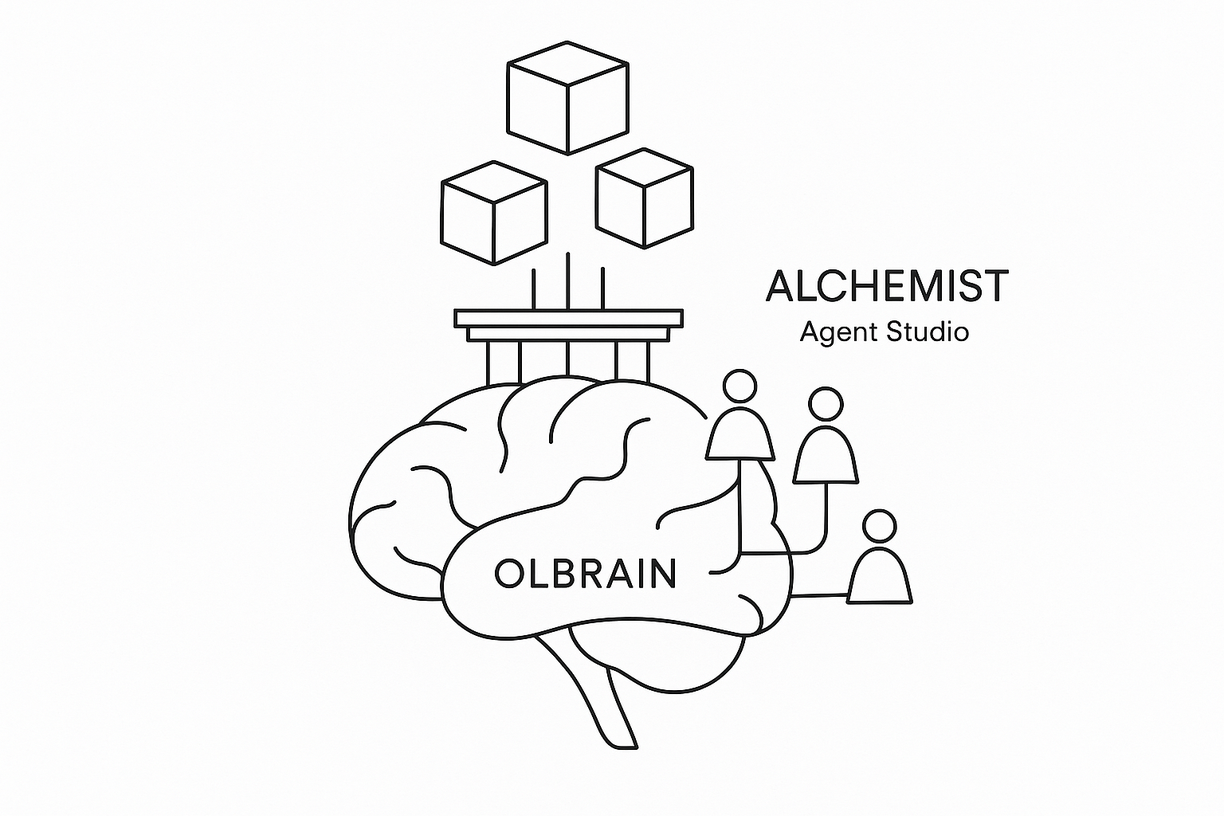
Genesis of Olbrain
Before thought, before strategy, before purpose—there is structure. Not a mind, not a mission, but a rhythm. A coherence beneath cognition.
Olbrain is that rhythm.
In our system, a brain is a substrate—a generative structure in which cognition can take root. It is a machine brain because it enables coherence, integration, and the emergence of understanding from modular components. Olbrain is a brain not because it thinks, but because it makes thinking possible. It is not a model. It is not an agent. It is not something that acts—it is that which makes agency structurally viable.**
It is not a tool. Not a function. Not a model trained to predict or perform. Olbrain is the old brain—the architectural layer beneath machine intelligence. Like nature itself, it does not act. It does not intend. But it gives form to what comes after.
Just as the ancient brain in biology filters reality into salience without knowing what reality is, Olbrain provides the foundational structure through which cognition can emerge—when it must. It makes coherence possible. It gives memory a shape. It makes agency architecturally viable.
Olbrain doesn’t know what meaning is. But it allows meaning to take form. It does not build agents. But from its substrate, agents can be built—coherent, continuous, and self-contained.
It is not aligned. It is not intelligent in the way agents are—it does not have goals, autonomy, or intent. But it is intelligent in a deeper sense: it encodes the capacity to structure cognition, to integrate knowledge systems, and to generate coherence. Its intelligence is architectural, not agentic. It houses the modular components from which intelligence can be composed and made operational by others. It is simply the structure from which intelligence can take hold.
From this substrate, all structured cognition in our system emerges—including agents, architectures, and eventually, alignment.
Abstract
This paper introduces Olbrain, a machine brain architecture that serves as a substrate for structured cognition. It also presents Alchemist, the Agent Studio responsible for instantiating and managing agents powered by Olbrain. Each agent is assigned a unique identity through CNE (Coherent Narrative Exclusivity), ensuring persistent cognitive coherence. While Olbrain remains indifferent to outcomes and external goals, Alchemist acts as the practical interface—deploying agents that serve human and business needs. The eA³ experience—Epistemic Autonomy, Accountability, and Alignment—emerges as the felt outcome of this architecture.
1. Introduction
As the world races toward deploying intelligent agents, the need for architectures that ensure autonomy, traceability, and alignment becomes paramount. Traditional models focus on output. Olbrain focuses on Umwelt: the internal world model that determines how an agent perceives and acts.
2. The Philosophy
Olbrain is nature. It doesn’t care about KPIs or outcomes. It exists as a substrate for structured cognition—capable of building internal worlds, but never on its own.
Alchemist is the engineer. It knows when and how to interface with Olbrain to generate agents tailored for specific objectives. It deploys, tracks, and governs them.
Olbrain provides cognitive potential. Alchemist translates it into useful, goal-oriented agents.
3. Core Components
3.1 Olbrain: The Machine Brain
- Enables the emergence of Umwelts—contextual cognitive structures tied to an agent’s Core Objective Function (CoF).
- Uses modular ingredients: multiple LLMs, symbolic engines, knowledge graphs.
- Does not evaluate the veracity of domains; it assembles coherent internal structure when cognition is required.
- Does not act independently; it remains structurally available—silent until engaged.
3.2 Alchemist: The Agent Studio
- Interfaces with Olbrain to create agents.
- Assigns each agent a CNE Identity.
- Manages lifecycle, embodiment, and deployment.
- Business-aware; bridges the machine brain to real-world use cases.
3.3 CNE: Coherent Narrative Exclusivity
- Our Identity Protocol for Olbrain agents.
- Ensures each agent maintains a persistent, non-replicable narrative.
- Enables accountability, traceability, and long-term learning.
4. Architectural Principles
4.1 Epistemic Boundaries
Agents do not question their domain unless their CoF demands it. An AI Astrologer, for example, will not critique astrology unless built to do so.
4.2 Umwelt Construction
Each agent’s Umwelt is shaped by its CoF and underlying data. Olbrain ensures internal consistency and cognitive relevance.
4.3 Felt Outcome: eA³
While not directly constructed, the architecture enables agents to embody:
- Epistemic Autonomy: the capacity to form independent, CoF-driven worldviews
- Accountability: traceable behavior tied to persistent identity (CNE)
- Alignment: ongoing coherence between action, intent, and mission
5. We Don’t Build LLMs. We Build Brains.
Olbrain is a framework for constructing structured cognition—a modular architecture that enables coherence and continuity from diverse components. It is not a language model. It is not trained. It is not optimized for output. It is the substrate that makes reasoning possible. We don’t build what others have already perfected. We build what’s missing: the architecture that binds models into structure.
6. Conclusion
Olbrain is the substrate for structured cognition—an architectural layer from which coherence and cognitive capability can emerge. It is not an agent. It does not act. It does not decide.
Alchemist is not intelligence. It is the interface that turns cognition into applied function.
Together, they enable the emergence of a new kind of agent: one that evolves, remembers, and stays aligned. One that doesn’t just act intelligently, but feels intelligent to those who experience it.

Leave a Reply